The Role of Voiceover in Video Storytelling

Stella writes SwipeStory guides about AI faceless video creation, short-form video strategy, creator tools, and automated publishing workflows.
Voiceover in video storytelling is defined as the narrative audio layer that guides audience interpretation, provides emotional context, and supplies meaning that visuals alone cannot deliver. Content creators and marketers who treat voiceover as optional are leaving their most powerful storytelling tool unused. The role of voiceover in video storytelling has grown sharper as short-form content floods TikTok, Instagram Reels, and YouTube Shorts, where fragmented visuals demand a steady narrative voice to hold meaning together. Swipestory's platform, which has generated over 60,000 short videos, reflects exactly this shift: voiceover is no longer a finishing touch. It is the spine of the story.
How does voiceover structure and clarify video narratives?
Voiceover functions as a narrative anchor in video content, stabilizing meaning when visuals move too fast for audiences to interpret on their own. Research published in 2026 confirms that voiceover in short-form video has shifted from a stylistic supplement to a core explanatory mechanism that guides interpretation in fragmented, high-speed visual environments. That shift matters because short-form platforms compress storytelling into seconds, leaving no room for visual ambiguity.
Visuals show events. Voiceover explains what those events mean. A clip of a crowded street tells you nothing about why the crowd gathered. A single narrated sentence, "This was the day the city voted to close its last coal plant," transforms the image into a story. Voiceover supplies historical background, thematic framing, and emotional stakes that no camera angle can communicate.
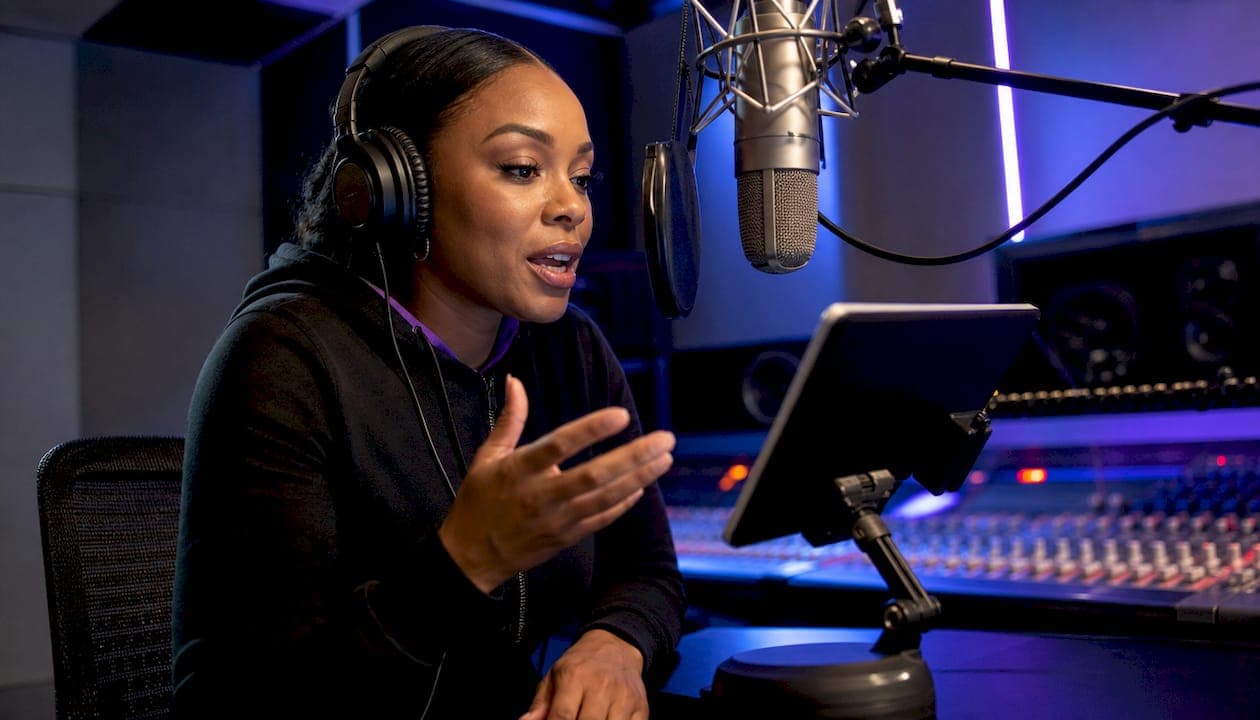
The "show, don't tell" rule that dominates film school thinking breaks down in short-form content. Audiences watching a 30-second Reel while commuting cannot decode layered visual metaphors. Voiceover compensates by telling directly, clearly, and fast. That is not a creative compromise. It is the correct tool for the format.
| Narrative function | What voiceover delivers |
|---|---|
| Context | Historical, thematic, or situational background |
| Emotional framing | Tone and feeling that images leave ambiguous |
| Pacing control | Guides how fast audiences process information |
| Thematic connection | Links separate visual moments into one coherent idea |
Pro Tip: Write your voiceover script before you shoot or edit your video. When narration drives structure, visuals become supporting evidence rather than the whole argument.
What techniques make voiceover more effective for storytelling?
The most effective voiceover shapes pacing, emphasis, and tone rather than relying on voice quality alone to connect emotionally. Voice actor Jennifer Tzoumas makes this point directly: pacing and emphasis do more narrative work than a rich baritone or a polished accent. That insight reframes how creators should approach voiceover production.
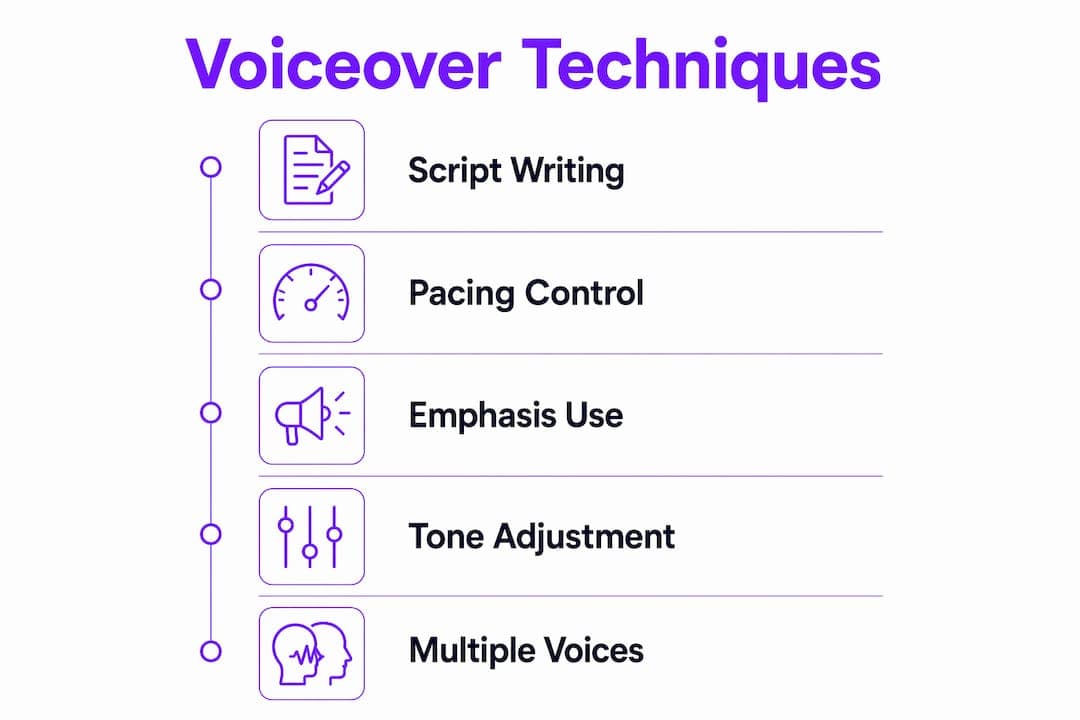
Scripting is where technique begins. Short, active sentences read better aloud than long compound constructions. "The factory closed in 1987" lands harder than "The factory, which had been operating since the early twentieth century, eventually closed its doors in 1987." Reading scripts aloud before recording is not optional. Documentary scripts are read 10–20% slower than corporate narration, because viewers process audio and visuals simultaneously and need time to absorb both.
Micro-choices in pitch and emphasis are where good narration becomes great storytelling. Professional voice artist Bridget Renshaw notes that subtle vocal adjustments in pitch and pacing trigger emotional responses that transform delivery into an authentic story experience. A slight drop in pitch signals gravity. A pause before a key word signals importance. These are not accidents. They are deliberate craft decisions.
Key techniques that consistently improve voiceover performance:
- Write short, active sentences. Subject, verb, object. No subordinate clauses stacked three deep.
- Read every draft aloud. If you stumble, the sentence is too long or too complex.
- Use deliberate pauses. Breathing pauses in long-form narration give editors flexibility and give audiences time to process what they just heard.
- Vary your pace intentionally. Speed up for excitement, slow down for weight. Monotone pacing kills engagement regardless of content quality.
- Avoid describing what viewers can already see. Professional guidelines are clear: voiceover should not describe visible images but provide what visuals cannot, including emotional insight and thematic connections.
Pro Tip: Record two or three takes of every key sentence at different pacing and emphasis. Give your editor options. The best take in isolation is rarely the best take in context.
Voiceover versus purely visual storytelling: when does narration win?
Visual storytelling depends on temporal and spatial coherence. The audience needs to understand where they are, when they are, and what connects one shot to the next. Feature films achieve this through careful editing, establishing shots, and scene-setting sequences. Short-form video has none of that time. A 60-second video cannot afford a 10-second establishing sequence.
Voiceover substitutes for that missing structure. It tells the audience where they are before the image has time to show them. It connects two visually unrelated clips with a single sentence of narration. This is why voiceover stabilizes meaning in fast-paced, fragmented video environments in ways that pure visual editing cannot replicate.
The multitasking behavior of social media audiences compounds this advantage. Viewers often watch videos without full visual attention, especially on mobile. A strong voiceover carries the story even when the screen is partially obscured or the viewer glances away. Visual-only storytelling loses those viewers entirely.
| Approach | Strengths | Where it falls short |
|---|---|---|
| Visual-only storytelling | Emotional immediacy, no language barrier | Requires sustained viewer attention and visual coherence |
| Voiceover narration | Guides meaning, supports multitasking, adds context | Requires strong scripting and pacing to avoid monotony |
| Combined approach | Maximum narrative depth and emotional range | Demands coordination between script, visuals, and audio |
Narrative depth is where the combined approach wins decisively. Voiceover adds the layer of meaning that images suggest but cannot confirm. The two channels reinforce each other when the narration adds something the visual does not already say.
Practical applications of voiceover in video marketing and content creation
Multiple voices in marketing video narration significantly increase consumer engagement and purchase likelihood. Large-scale research confirms that the number and quality of voices in a marketing video influence consumer processing, often subconsciously. A single narrator builds consistency. Multiple narrators build credibility and variety. Both are valid strategies, but they serve different goals.
Aligning voiceover style with brand tone is not a branding exercise. It is a comprehension exercise. A financial services brand that uses a casual, fast-paced narrator creates cognitive dissonance. The voice signals one thing; the content signals another. Audiences feel the mismatch even when they cannot name it. Match the narrator's register to the content's emotional weight.
Practical applications where voiceover delivers the clearest return:
- Explainer videos. Voiceover carries the instructional load while visuals demonstrate the process. The text to video AI workflow on Swipestory is built exactly for this format.
- Educational content. Narration paces the learning. Viewers absorb information faster when audio guides them through visual steps.
- Faceless video content. Creators who do not want to appear on camera rely entirely on voiceover to build audience connection. A faceless video generator paired with strong narration produces content that performs as well as on-camera formats.
- Short-form social media. Voiceover hooks viewers in the first two seconds, before the algorithm decides whether to keep showing the video.
- AI-assisted production. AI voiceover tools reduce production time without sacrificing narrative quality. Swipestory automates the voiceover generation process from script to final render, which means creators spend time on story decisions rather than technical setup.
Narrative rhythm, editorial awareness, and emotional control are the techniques that sustain audience attention across longer formats. These principles apply equally to a 90-second brand video and a 10-minute documentary segment.
Key Takeaways
Voiceover is the primary narrative mechanism that gives video content meaning, emotional direction, and audience retention that visuals alone cannot achieve.
| Point | Details |
|---|---|
| Voiceover anchors meaning | It stabilizes interpretation in fast-paced, fragmented video formats where visuals cannot carry the full story. |
| Pacing and emphasis matter most | Effective narration depends on deliberate pacing and micro-choices in tone, not voice quality alone. |
| Avoid describing the visible | Narration should add emotional insight and context, not repeat what viewers can already see. |
| Multiple voices boost engagement | Using more than one narrator in marketing video increases consumer engagement and purchase likelihood. |
| AI tools reduce production barriers | Platforms like Swipestory automate voiceover generation, letting creators focus on story quality over technical execution. |
Why voiceover is the most underrated tool in a creator's kit
Creators obsess over thumbnails, hooks, and editing rhythm. Voiceover gets treated as an afterthought, something to record quickly once the visuals are locked. That sequencing is backwards. The narration should shape the edit, not follow it.
What I have seen consistently is that the gap between average and great video content is almost never the footage. It is the narration. A mediocre clip with a confident, well-paced voiceover outperforms beautiful footage with flat or redundant narration. The voice is doing the emotional heavy lifting that the image cannot.
The subtlety that separates good voice work from great voice work is harder to teach than people expect. It is not about sounding professional. It is about long-form editorial awareness, knowing when to slow down, when to let a pause breathe, and when to push forward. Most creators never develop that instinct because they record one take and move on.
AI voiceover tools change the production equation, but they do not change the storytelling equation. The script still has to be good. The pacing decisions still have to be intentional. What AI removes is the technical barrier, the recording setup, the editing time, the cost of hiring a voice actor for a 60-second clip. That is genuinely useful. But creators who treat AI narration as a substitute for thinking about what their voiceover should say will produce content that sounds polished and means nothing.
— Jesse
Swipestory makes voiceover-driven video creation faster
Swipestory's AI video tools are built for creators who want narration and visuals to work together from the start, not as separate production steps bolted together at the end.
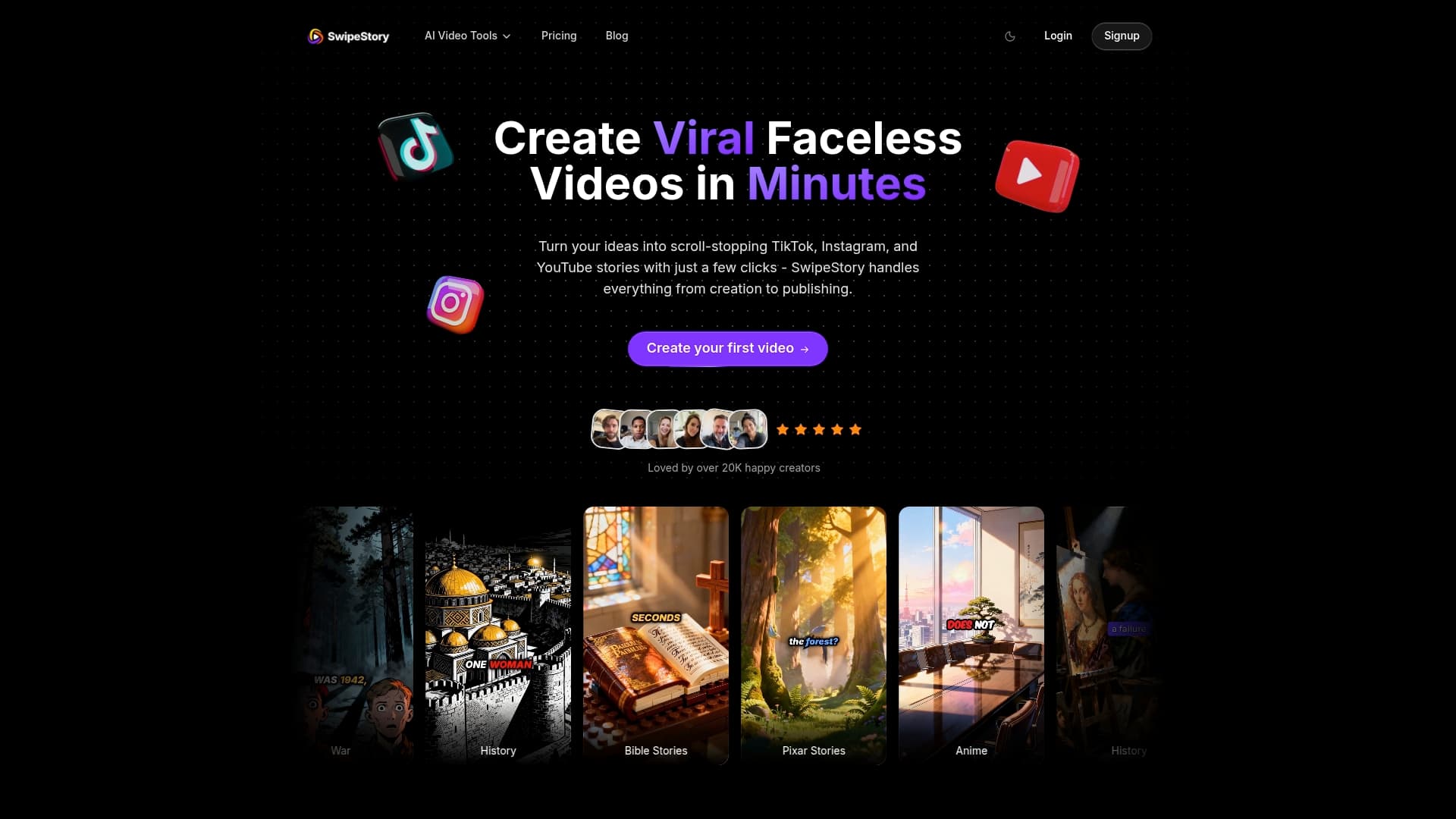
The platform's AI video generator handles scriptwriting, voiceover generation, and rendering in a single workflow. Creators working on short-form content can use the script to video AI tool to turn a narration draft directly into a finished video, with voiceover synced to visuals automatically. Swipestory has already generated over 60,000 short videos for creators across TikTok, Instagram, and YouTube. The tools are designed so that the story comes first and the production follows without friction.
FAQ
What is the role of voiceover in video storytelling?
Voiceover provides the narrative layer that gives video content context, emotional direction, and thematic meaning beyond what visuals can show. It guides audience interpretation and stabilizes meaning in fast-paced or fragmented video formats.
How does voiceover enhance short-form video content?
Voiceover compensates for the lack of visual setup time in short-form video by delivering context and emotional framing in seconds. Research confirms it has become a core explanatory mechanism in high-speed visual environments like TikTok and Instagram Reels.
What are the most effective voiceover techniques for storytelling?
The most effective techniques include writing short active sentences, reading scripts aloud for pacing, using deliberate pauses, varying pace intentionally, and avoiding narration that simply describes what viewers can already see.
Does using multiple voices in a video improve marketing results?
Research using large-scale datasets shows that multiple narrators in marketing video significantly increase consumer engagement and purchase likelihood compared to single-voice narration.
How is AI changing voiceover production for content creators?
AI tools automate voiceover generation from script to final audio, reducing production time and cost without changing the need for strong scripting and intentional pacing decisions.
