
Best Niches for Faceless Videos

Stella writes SwipeStory guides about AI faceless video creation, short-form video strategy, creator tools, and automated publishing workflows.
The best niches for faceless videos in 2026 are AI tool tutorials, history and true-story explainers, science and space, beginner finance education, career advice, productivity systems, brand breakdowns, language learning, myth-busting, and niche news recaps. The safest choice is not the niche with the loudest viral example. It is the niche where you can publish original scripts, repeat the format, use rights-safe visuals, and still give viewers a clear reason to watch without seeing your face.
Updated May 28, 2026. We checked current YouTube Help pages, TikTok support pages, TikTok Creative Center guidance, Meta's AI labeling update, StoryShort's public positioning, and existing SwipeStory content before writing this guide.
Quick Verdict: The Best Faceless Video Niches
If you want the shortest answer, start with one of these:
| Niche | Why it works for faceless videos | Best format |
|---|---|---|
| AI tool tutorials | The screen, workflow, and result become the visual | 30-60 second walkthroughs |
| History and true stories | Strong curiosity, easy scene prompts, repeatable structure | "The strange reason..." explainers |
| Science and space | Visual by nature and good for short questions | One question, one answer |
| Career advice | Practical, evergreen, and easy to script | Mistake/fix videos |
| Productivity systems | Framework-heavy and visual without a host | Three-step systems |
| Brand breakdowns | Built-in examples and strong commentary angle | "Why this worked" clips |
| Language learning | Small lessons fit short-form perfectly | One phrase or mistake per video |
| Myth-busting | Strong hooks and clear payoffs | Claim, evidence, correction |
| Niche news recaps | Built-in freshness when you can research carefully | One update, one implication |
For most creators, the winner is the niche you can turn into a repeatable series. That is where SwipeStory's faceless AI video generator fits best: it turns prompts or scripts into vertical videos with AI-generated visuals, voiceovers, captions, background music, editing, rendering, and scheduled publishing for TikTok, YouTube Shorts, and Instagram Reels.
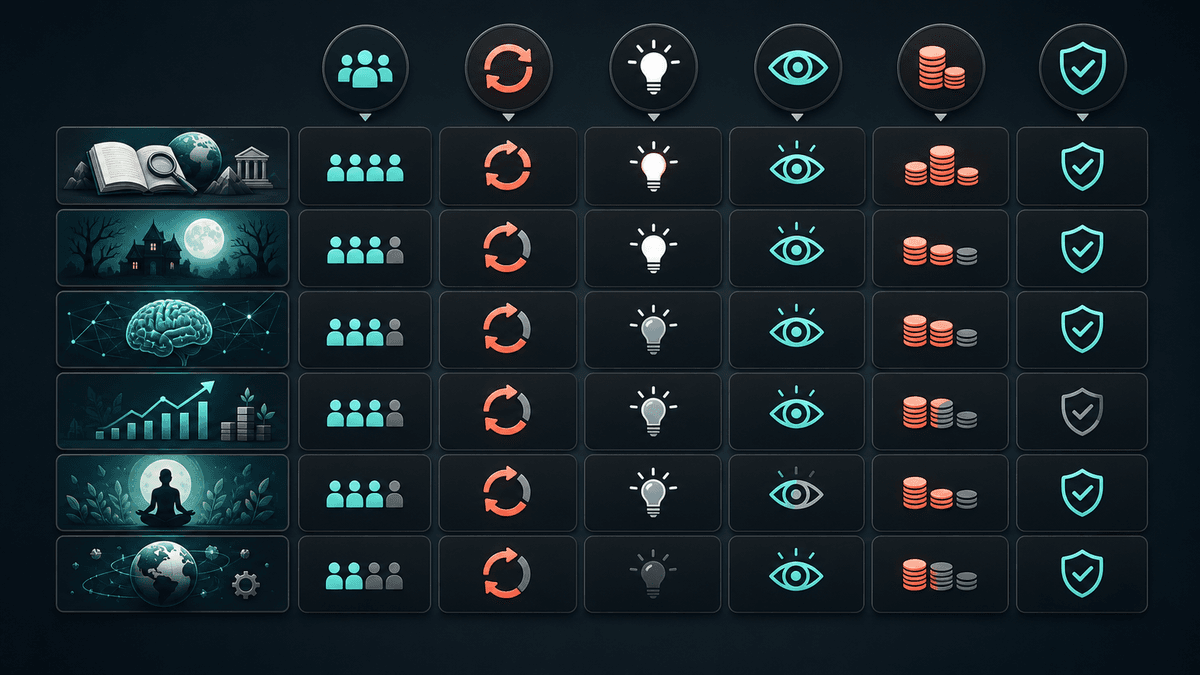
How to Score a Faceless Video Niche
Do not pick a niche only because someone says it has a high RPM, goes viral, or can be automated. Those claims are usually missing the hard part: making original videos that survive platform review and keep viewers watching.
Use this six-part filter instead:
| Filter | Good sign | Warning sign |
|---|---|---|
| Search demand | People already ask recurring questions | You are guessing from one viral clip |
| Repeatability | You can write 50 hooks without forcing it | You run out of topics after five posts |
| Originality | You add commentary, structure, examples, or research | You mostly repackage other clips |
| Visual clarity | The idea can be shown with scenes, screenshots, charts, or generated visuals | The value depends on a host personality |
| Safety | Claims are low-risk and easy to source | The niche drifts into medical, legal, or financial advice |
| Platform fit | It works in vertical, caption-heavy feeds | It needs long context before the payoff |
The top niches usually score well on at least four of those six. AI tool tutorials, history, science, language learning, career advice, and brand breakdowns work because the viewer can understand the value quickly. A person on camera can help, but the format does not depend on it.
This is also why "faceless" should be treated as a format, not a business model. If you still need the broader production process, read how to make faceless videos with AI before choosing your first niche.
Platform Rules That Should Shape Your Niche Choice
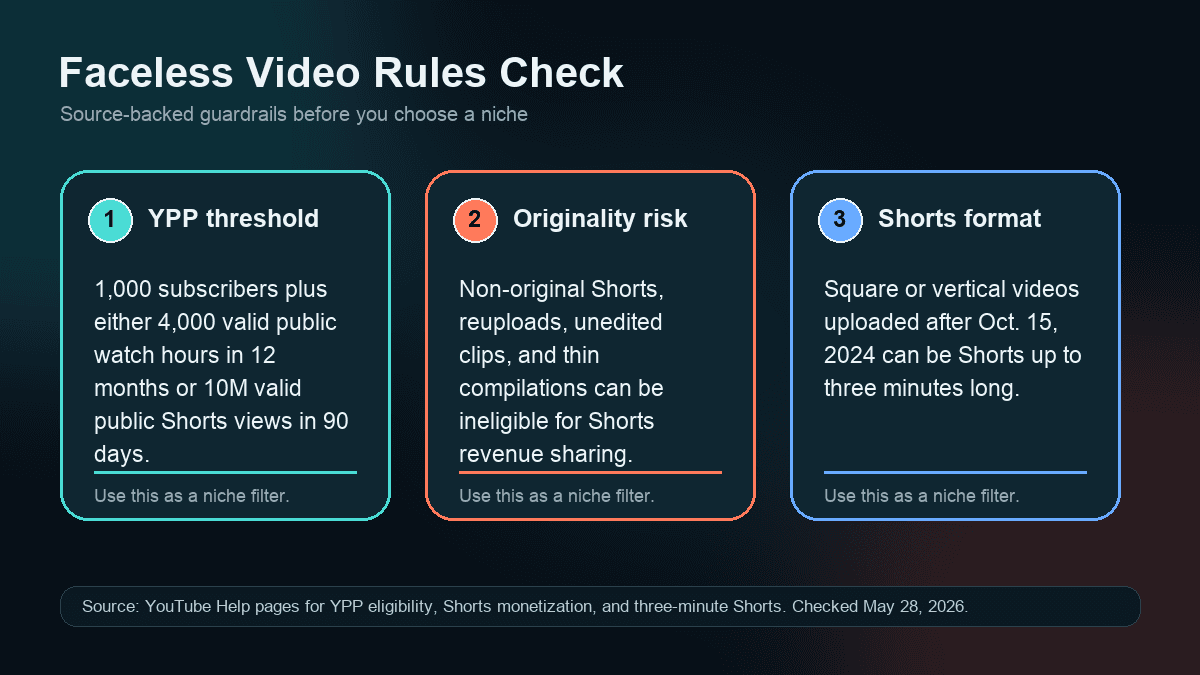
A niche is weaker if it only works by copying other people's clips. Current platform guidance makes that risky.
YouTube's Partner Program overview says creators can become eligible with 1,000 subscribers plus 4,000 valid public watch hours in the last 12 months, or 1,000 subscribers plus 10 million valid public Shorts views in the last 90 days. YouTube also says channels need to follow monetization policies, have no active Community Guidelines strikes, and pass review. Source: YouTube Partner Program overview and eligibility.
That matters because YouTube's Shorts monetization policy lists non-original Shorts, reuploads, unedited clips, and compilations without original content as examples of views that can be ineligible for revenue sharing. Source: YouTube Shorts monetization policies.
The practical takeaway: pick niches where your script is the asset. A faceless channel built on original explanation, research, examples, or visual storytelling is much safer than a channel built on recycled clips.
YouTube's current Shorts guidance also says square or vertical videos uploaded on or after October 15, 2024 can be categorized as Shorts up to three minutes long. Source: Understand three-minute YouTube Shorts. That gives faceless creators more room for story formats, but it does not mean every video should be long. Most beginner channels should still test one clear idea in 20-60 seconds before expanding.
12 Faceless Video Niches Worth Testing
1. AI Tool Tutorials
AI tool tutorials are one of the strongest faceless video niches because the tool result becomes the visual proof. You can record or generate the workflow, narrate the benefit, and keep the format tight.
Good angles:
- "I tested one AI feature so you do not have to."
- "Three prompts that make this tool more useful."
- "Before you pay for this tool, check this setting."
This niche pairs well with AI video prompts for Shorts because each video can start from a structured prompt and turn into a repeatable scene plan.
2. History and True-Story Explainers
History works because the hook is often built in: strange decisions, forgotten inventions, military mistakes, dramatic escapes, ancient customs, and "what happened next" stories. Faceless visuals can be maps, documents, generated scenes, timelines, or symbolic animation.
The quality bar is research. Do not invent details to make a story more cinematic. Use a source, keep the claim narrow, and make the script clear about what is known.
3. Science and Space Questions
Science and space videos work well when each Short answers one question:
- "Why does this planet spin backward?"
- "What would happen if the moon disappeared?"
- "Why do astronauts train underwater?"
The format is visual without needing a host. Use diagrams, generated scenes, stock clips, captions, and voiceover. Keep claims simple and source anything that sounds surprising.
4. Beginner Finance Education
Finance can be valuable, but it needs careful framing. The safest faceless finance videos explain terms, habits, mistakes, budgeting frameworks, or historical examples. Avoid personalized investment advice, guaranteed income claims, or "copy this trade" content.
Good format:
Hook: "This one budgeting mistake makes your income feel smaller."
Setup: "It happens when fixed costs quietly grow."
Example: "A $19 subscription looks harmless until seven of them stack."
Payoff: "Audit recurring expenses before increasing income goals."
5. Career Advice and Workplace Psychology
Career advice is strong because it is practical and repeatable. The visuals can be resumes, calendars, interview scenes, office metaphors, or simple text-led storyboards.
Good angles:
- Interview mistakes.
- Resume before/after explanations.
- First manager lessons.
- Salary negotiation scripts.
- "What your boss actually notices" videos.
The important guardrail is specificity. A generic motivational clip sounds automated. A narrow career problem feels useful.
6. Productivity Systems
Productivity is a strong faceless niche because systems are easy to visualize. You can show calendars, dashboards, time blocks, task boards, and mental models without showing your face.
The best version is not "wake up at 5 a.m." content. It is practical systems content:
- How to plan tomorrow in five minutes.
- Why most to-do lists fail.
- A three-step review for busy weeks.
- How to reduce decision fatigue.
If you want this niche to become a series, build one repeatable format: problem, cause, fix, example.
7. Brand and Marketing Breakdowns
Brand breakdowns work because the value is commentary. The viewer wants to understand why an ad, landing page, product launch, pricing page, hook, or offer worked.
This is a better niche for creators who can form opinions. Do not just show a famous brand and call it analysis. Explain one decision and one lesson.
Good format:
| Beat | Example |
|---|---|
| Hook | "This landing page makes one smart choice most founders miss." |
| Evidence | "The offer is visible before the feature list." |
| Lesson | "Lead with the outcome, then explain the mechanism." |
| CTA | "Save this before you rewrite your own page." |
8. Language Learning Micro-Lessons
Language learning is naturally short-form. One pronunciation mistake, one phrase, one grammar pattern, or one travel sentence can become a complete faceless video.
This niche is especially strong if you can add audio, captions, and repetition. Use the same visual template each time so viewers recognize the series.
9. Myth-Busting
Myth-busting works because it gives you a built-in hook:
- "You were taught this wrong."
- "This advice sounds smart but fails in practice."
- "Most people misunderstand this chart."
It works across productivity, business, health habits, history, AI tools, education, careers, and creator strategy. The risk is overclaiming. Keep the correction narrow and explain why it matters.
10. Software Walkthroughs
Software walkthroughs are a more tactical version of AI tool tutorials. They work for SaaS, productivity apps, creator tools, design tools, analytics tools, and workflows.
This niche is a good fit for SwipeStory's AI TikTok video generator and AI YouTube Shorts generator because one tutorial idea can become a platform-specific draft with a hook, narration, captions, and vertical pacing.
11. Wellness Habits
Wellness can work when it stays practical: sleep routines, walking habits, breathing prompts, planning rituals, screen-time boundaries, meal-prep organization, and stress reduction habits. Avoid diagnosing, treating, or making medical claims.
The best faceless wellness videos feel like a calm system, not a cure.
12. Niche News Recaps
News recaps can work if you narrow the field. Instead of "today's news," choose creator economy updates, AI product launches, app updates, ecommerce policy changes, real estate market explainers, or industry-specific changes.
The upside is freshness. The downside is research load. If you cannot verify the update quickly, choose an evergreen niche instead.
Validate Demand Before You Batch Videos
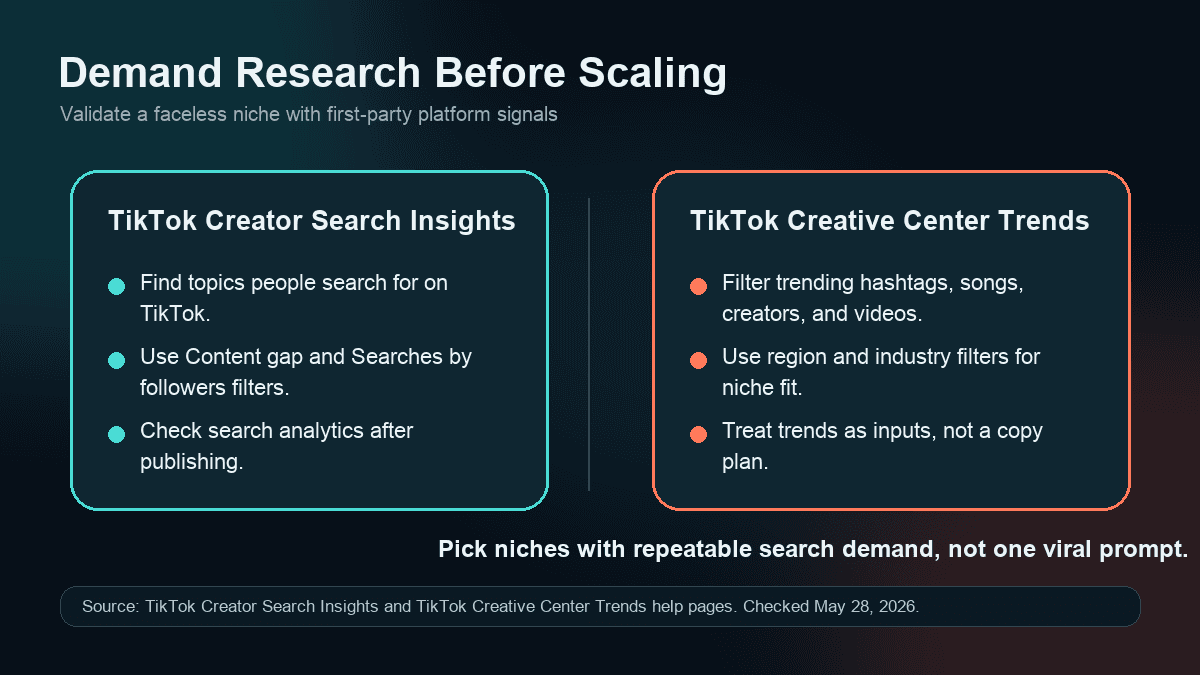
Before you create 30 videos, validate demand in small batches.
TikTok's Creator Search Insights support page says the tool gives creators personalized information about topics people search for on TikTok, including popular searches, content gaps, follower searches, and search analytics for posts. Source: TikTok Creator Search Insights.
TikTok's Creative Center Trends help page says Trends displays trending hashtags, songs, creators, and videos by region and industry. Source: TikTok Creative Center Trends.
Use those tools as research inputs, not scripts to copy. A good validation pass looks like this:
- Pick three possible niches.
- Collect 20 recurring search topics or viewer questions for each.
- Write five hooks per niche.
- Produce three videos per niche.
- Compare retention, saves, comments, and search-driven views.
- Keep the niche where the next 30 ideas are easiest to write.
If a niche needs constant trend chasing to work, it may be weaker than it looks. The best faceless video niches give you evergreen questions plus timely examples.
AI Disclosure Can Change the Risk Profile
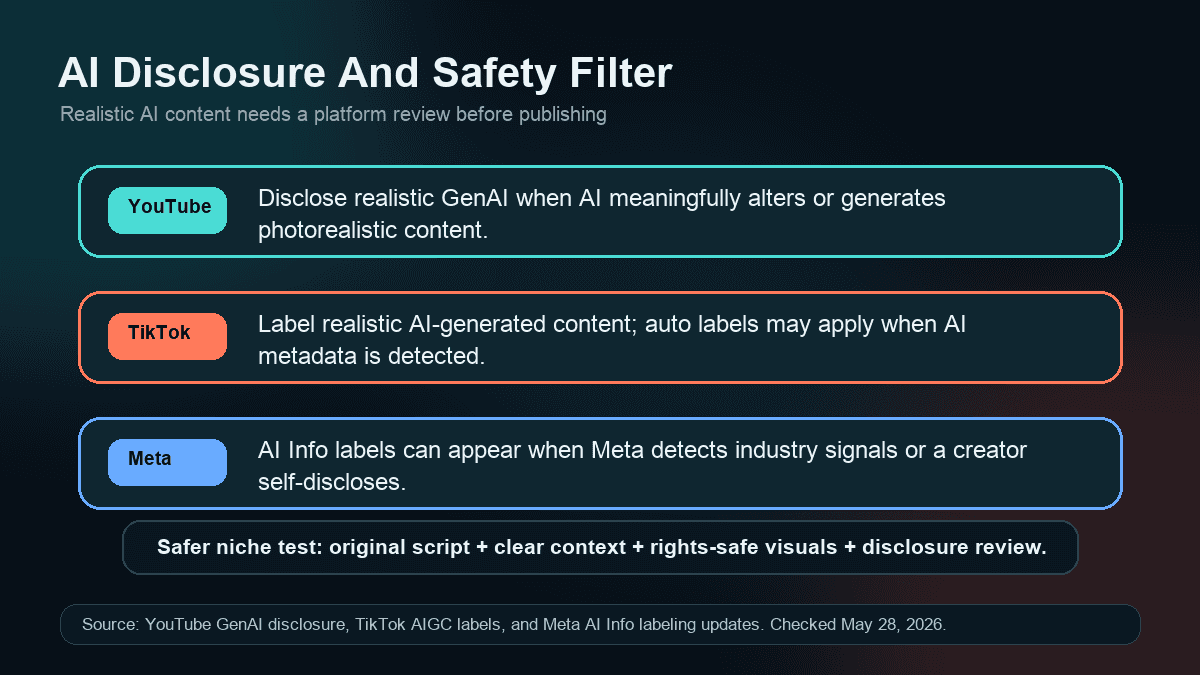
If your faceless niche uses realistic AI visuals or audio, build disclosure review into the workflow.
YouTube says creators must disclose when they use AI to meaningfully alter or generate photorealistic content, including realistic scenes that did not occur. Source: YouTube GenAI disclosure guidance.
TikTok says creators are required to label AI-generated content that contains realistic images, audio, or video, and that TikTok may also apply AI labels automatically when it identifies AI-generated or significantly edited content. Source: TikTok AI-generated content guidance.
Meta says its platforms use "AI info" labels when AI indicators are detected or when people disclose that they are uploading AI-generated content. Source: Meta AI labeling update.
This does not mean AI faceless videos are off limits. It means some niches need more review. A fictional animated explainer has a different risk profile than a realistic AI video showing a public figure, a fake disaster, a fake medical event, or a real person saying something they never said.
How to Turn One Niche Into a SwipeStory Series
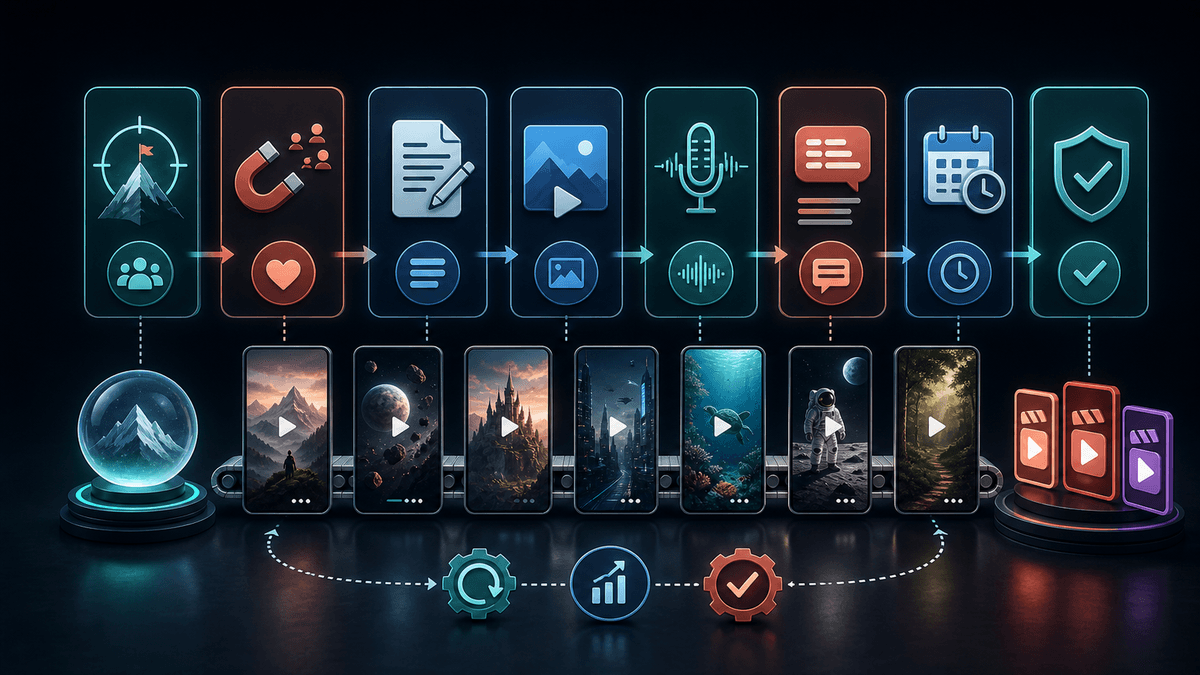
Once you pick a niche, do not start with a random prompt every day. Build a series format.
Use this structure:
Niche: AI tool tutorials for small business owners
Audience: founders who want useful AI workflows without wasting time
Promise: one practical tool setting, workflow, or prompt per video
Format: hook, pain point, example, result, next step
Visual style: clean screen-style visuals, generated product metaphors, captions
Publishing rhythm: three Shorts, three TikToks, three Reels per week
Then create three recurring series templates:
| Series template | Example |
|---|---|
| Mistake/fix | "The AI prompt mistake that makes outputs generic" |
| Tool test | "I tested this feature for 20 minutes. Here is what matters." |
| Mini workflow | "Turn one messy idea into a 30-second video script." |
This is where SwipeStory is strongest. You can turn the niche brief into scripts, visuals, voiceover, captions, music, editing, rendering, and scheduled publishing without stitching together separate tools. For platform-specific production, use the AI Reel generator, AI TikTok video generator, or AI YouTube Shorts generator.
Niches I Would Avoid First
Some faceless video niches are popular but hard for beginners to execute well.
Avoid these as your first test:
| Niche pattern | Why it is risky |
|---|---|
| Generic motivation | Very saturated and often indistinguishable |
| Clip compilation channels | Originality and rights issues are hard to manage |
| Medical advice | High trust burden and easy to overclaim |
| Investment picks | Personal finance risk and compliance concerns |
| Public figure deepfakes | High disclosure and impersonation risk |
| Broad news | Too much research load and short shelf life |
| Random facts | Weak retention unless you add a point of view |
This does not mean you can never create in these areas. It means they require stronger sourcing, stronger editing, and a clearer reason to exist.
Starter Prompts for the Best Faceless Video Niches
Use these prompts as starting points, then replace the audience, claim, and examples with your own research.
AI tool tutorial
Create a 35-second faceless video for small business owners explaining one AI tool workflow. Open with a practical mistake, show one concrete example, and end with a quick next step.
History explainer
Create a 45-second faceless history Short about one surprising decision from [event]. Use a curiosity hook, three factual beats, and a clear lesson. Do not invent dates or names.
Career advice
Create a 30-second faceless career advice video for early professionals. Start with one interview mistake, explain why it hurts, and give a better line they can use.
Brand breakdown
Create a 40-second faceless brand breakdown about why [company/page/ad] works. Focus on one decision, one piece of evidence, and one lesson viewers can apply.
Language learning
Create a 25-second language learning video teaching one phrase in [language]. Include pronunciation guidance, a simple example, and a repeatable caption pattern.
If you want more reusable script structures, pair these with YouTube Shorts script templates and TikTok hook examples.
Frequently Asked Questions
What is the best niche for faceless videos for beginners?
AI tool tutorials, productivity systems, career advice, language learning, and history explainers are strong beginner choices because they are repeatable, visual, and easier to make original than copied clip formats.
Are faceless YouTube niches different from TikTok niches?
The format overlaps, but the validation process is different. YouTube rewards search, retention, originality, and channel consistency. TikTok can move faster around trends and search gaps. If you plan to publish on both, choose a niche with evergreen questions and short-form hooks.
Can AI-generated faceless videos be monetized?
They can be monetized when they meet the platform's eligibility, originality, rights, and policy requirements. The safer path is original scripting, rights-safe visuals, clear disclosure where required, and enough human review to avoid mass-produced repetition.
How many niches should I test at once?
Test two or three, not ten. Publish three to five videos per niche, compare watch time and engagement, then choose the one that is easiest to write and most promising to repeat.
Sources
- YouTube Partner Program overview and eligibility
- YouTube Shorts monetization policies
- Understand three-minute YouTube Shorts
- YouTube GenAI disclosure guidance
- TikTok Creator Search Insights
- TikTok Creative Center Trends
- TikTok AI-generated content guidance
- Meta AI labeling update
- StoryShort public product positioning
If you want the fastest path from niche to publishable test batch, start with SwipeStory's faceless AI video generator. Pick one niche, write three focused prompts, and turn them into a small series before scaling.
