How AI Selects Visuals for Videos: A Creator's Guide

Stella writes SwipeStory guides about AI faceless video creation, short-form video strategy, creator tools, and automated publishing workflows.
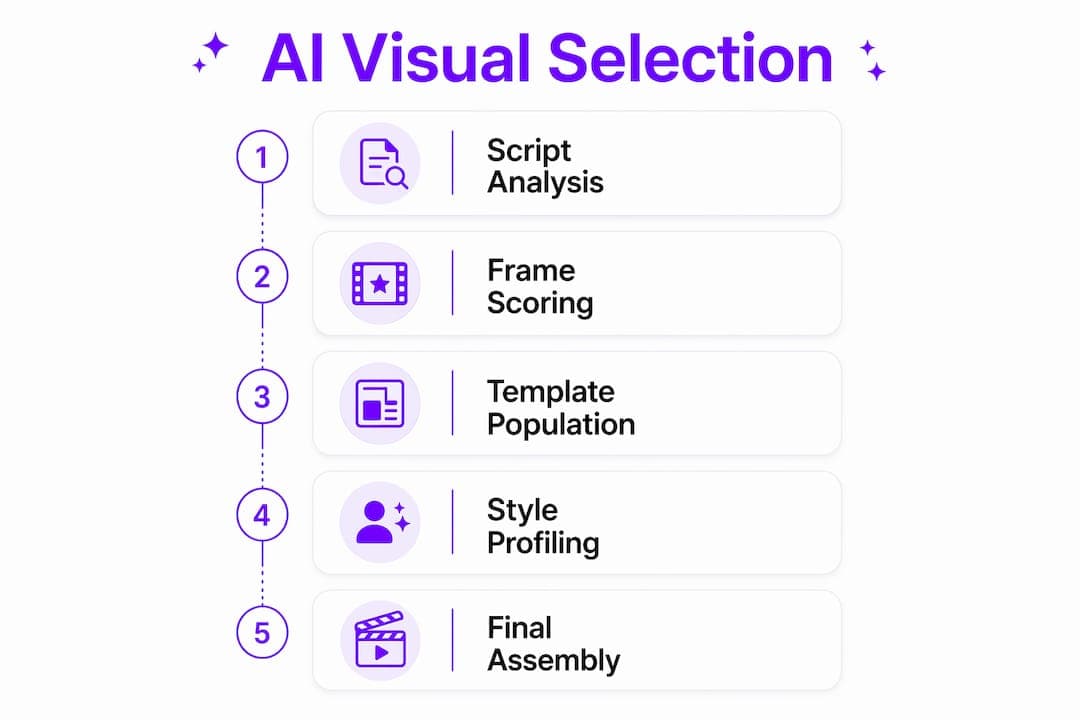
AI selects visuals for videos by analyzing script context, narrative structure, and viewer data to automatically match or generate the most relevant imagery for each moment. This is not random sampling. The process draws on machine learning models trained to score frames for semantic relevance, visual continuity, and emotional tone, then populates modular video templates with those selections in real time.
Here is what that looks like in practice:
- Script analysis: AI reads the full script to identify topics, emotional beats, and scene transitions before a single visual is chosen.
- Adaptive frame selection: Algorithms score candidate frames against the query or narrative context, prioritizing diverse, relevant frames over redundant ones.
- Modular templates with dynamic slots: A reusable video shell holds static brand elements while AI fills dynamic slots with visuals drawn from stock libraries or generated on demand.
- One-to-one personalization: The shift from broadcasting one video to thousands of viewers to rendering a unique video for each individual is now driven entirely by data-fed template systems.
- Swipestory applies all of these methods in a single platform, letting creators go from script to finished short video without touching a timeline editor.
Table of Contents
- How AI chooses visuals for videos: the core technologies
- How creators and marketers can use AI visual selection effectively
- How Swipestory applies AI visual selection at scale
- Where AI visual selection still falls short
- Where AI-driven visual selection is already working
- What personalized visuals actually do to viewer engagement
- Key Takeaways
- Swipestory puts AI visual selection within reach for every creator
How AI chooses visuals for videos: the core technologies
Script analysis and contextual segmentation
Before any visual is selected, AI reads the entire script. This is not keyword matching. The model identifies emotional tone, topic clusters, and scene boundaries, then segments the script into units that each need a distinct visual treatment. A line about "morning routines" triggers different imagery than one about "productivity tools," even if both appear in the same video. AI visual matching analyzes scripts for context and emotional tone, generating visuals consistent with a defined style profile for brand coherence.

Adaptive and query-aware frame selection
Uniform frame sampling, where you grab one frame every N seconds, misses the point. Modern systems use query-aware frame selection that scores each candidate frame against the semantic content of the query or script segment. The best methods balance two signals: how relevant a frame is to the current topic, and how visually distinct it is from frames already selected. Redundant frames waste token budget and dilute attention.
Research from CVPR 2025 shows that M-LLM-based frame selectors use both spatial signals (per-frame importance scores) and temporal signals (caption-level reasoning across all frames) to identify which moments carry the most information. The result is a lightweight selector that improves video understanding across short, medium, and long video benchmarks without retraining the downstream model.
Pro Tip: When building a video template, label each dynamic slot with a semantic tag ("product_demo," "testimonial_moment") rather than a generic placeholder. AI systems that read those tags can match visuals far more precisely than systems working from position alone.
Modular templates and dynamic slot population
The template architecture is what makes personalization scalable. A video template defines static layers (logo, color palette, font) and dynamic slots (headline text, background clip, product image). At render time, AI pulls from a data source, whether a CRM record, a product catalog, or a spreadsheet row, and fills each slot automatically. Branching logic and dynamic slots let the system swap entire visual sequences based on viewer attributes, not just swap a name in a text field.
One template plus a thousand data rows produces a thousand unique videos. That is the core mechanic behind template-driven video automation and the reason personalized video at scale is now a realistic option for mid-size marketing teams, not just enterprise budgets.
Generative models vs. stock libraries
AI platforms now offer two sourcing paths for visuals. Stock libraries provide fast, pre-cleared imagery but limit creative range. Generative models, including high-resolution architectures like Flux and Veo, produce fully custom scenes at full resolution, tailored to the script's specific visual requirements. The practical choice depends on brand needs: stock works for speed and consistency; generative AI works when the visual needs to be unique or when no stock image captures the right moment.
Visual consistency and style profiles
Brand coherence across a batch of AI-generated videos requires a style profile: a defined set of color grading rules, composition preferences, and typographic standards the AI applies to every visual it selects or generates. Without this, a hundred personalized videos look like they came from a hundred different brands. Style profiles are the guardrail that keeps automated visual selection on-brand at volume.
How creators and marketers can use AI visual selection effectively
The biggest mistake creators make is treating AI visual selection as a black box they hand off entirely. The better approach is structured input with human review at key checkpoints.
- Feed the AI clean data. The quality of visual selection depends directly on the quality of the script and the data source. Vague scripts produce generic visuals. Specific, segmented scripts produce precise matches.
- Use semantic slot labels in templates. Generic placeholders produce generic fills. Named slots tied to content categories give the AI enough context to make meaningful choices.
- Maintain a visual style profile. Define your color palette, preferred shot types, and typography before you generate anything. Apply it as a constraint, not a suggestion.
- Match frame selection to narrative pacing. Fast-cut sequences need high-diversity frame sets; explanatory segments need frames with strong semantic alignment to the spoken content.
- Review AI output for emotional accuracy. Algorithms optimize for relevance and diversity, not for the specific emotional register your brand needs. A human pass catches the frame that is technically relevant but tonally wrong.
Pro Tip: Run a small batch of 10–20 AI-generated videos before scaling to thousands. Spot-check for visual consistency, emotional alignment, and brand accuracy. Fixing a template flaw at 20 videos costs nothing; fixing it at 10,000 is a production restart.
Marketers running AI-powered video campaigns consistently find that the highest-performing videos combine automated visual selection with a human creative brief that specifies tone, pacing, and the one visual moment the video must land. AI handles the volume; the brief handles the intent.
How Swipestory applies AI visual selection at scale
Swipestory has helped thousands of creators produce over 60,000 AI-generated short videos using a modular template system that automates visual selection from script to final render.
The platform's core workflow:
- Script-to-visual pipeline: Users input a script or topic; Swipestory's AI segments it and selects or generates matching visuals for each segment automatically.
- Customizable captions: Text overlays are generated and timed to match the visual and audio track, with full style control.
- AI image generation: When stock visuals do not fit, the platform generates custom imagery at render time, keeping the video visually coherent with the script's specific content.
- Cloud rendering: Videos render in the cloud, meaning no local processing power is required and output is ready in minutes.
- Platform-ready output: Final videos are formatted for TikTok, Instagram Reels, and YouTube Shorts without manual resizing.
The platform is built for creators who need volume without sacrificing visual quality. A creator producing daily short-form content for multiple platforms can generate a week's worth of videos in a single session.
Where AI visual selection still falls short
AI visual selection is not perfect. Three limitations show up consistently in production environments.
Emotional nuance is hard to automate. A frame can be semantically correct and still feel wrong for the moment. AI scores relevance; it does not score emotional resonance with the precision a human editor does.
Training data bias shapes output. Models trained predominantly on certain visual styles, demographics, or content categories will over-index on those patterns. Creators working in niche or underrepresented categories often find AI selections feel generic or off-target.
Long-form coherence degrades. Frame selection methods that work well on short clips can lose narrative thread across longer videos. Maintaining visual consistency and story logic across a 10-minute video is a harder problem than selecting frames for a 60-second clip.
Where AI-driven visual selection is already working
E-commerce brands use AI visual selection to generate product videos at catalog scale, one video per SKU, each with visuals matched to the product's category, color, and use case. Financial services teams use template-based rendering for personalized statement explainers, where compliance requires predictable, auditable output. SaaS companies generate onboarding videos personalized to each user's account data, with visuals matched to the specific features they have activated. Tools like Prose Coach show how AI personalization extends beyond video into the full content layer, adapting tone and style to individual users.
The online video platform market is projected to grow from $14.02B in 2025 to $17.08B in 2026, with demand for personalized video experiences cited as a primary driver.
What personalized visuals actually do to viewer engagement
Personalized visuals hold attention longer because they signal relevance immediately. A viewer who sees imagery matched to their industry, behavior, or stated preferences does not have to work to connect the content to their situation. That cognitive shortcut translates directly into watch time.
The most effective personalization hook is often the simplest: a visual that reflects the viewer's own context, whether that is their name, their product, or their location. The first-name effect in personalized video is well-documented: people notice their own name and respond to it with immediate attention. The same principle applies to visual personalization. When the imagery matches the viewer's world, the video feels made for them, because it was.
Key Takeaways
AI selects visuals for videos by combining script-level context analysis, query-aware frame scoring, and modular template systems to deliver personalized, brand-consistent imagery at scale.
| Point | Details |
|---|---|
| Script analysis drives selection | AI segments the full script by topic and tone before choosing any visual, producing precise matches rather than generic fills. |
| Frame selection balances relevance and diversity | Effective AI methods score frames for both semantic alignment and visual distinctiveness, avoiding redundant selections. |
| Templates enable one-to-one scale | Dynamic slot architecture lets one template generate thousands of unique videos from a single data source. |
| Style profiles protect brand coherence | Defining color, composition, and typography rules before generation keeps AI output consistent across large video batches. |
| Swipestory automates the full pipeline | Swipestory's AI handles script segmentation, visual selection, image generation, and cloud rendering, producing platform-ready short videos in minutes. |
Swipestory puts AI visual selection within reach for every creator
Most creators know AI can help with video, but the gap between knowing that and actually shipping 30 polished videos a month is where most tools fall short. Swipestory closes that gap by handling the entire visual selection and production pipeline automatically, from parsing your script to rendering a finished video formatted for TikTok, Reels, or Shorts.
You do not need a production team or a timeline editor. Swipestory's modular template system selects and generates visuals matched to your script's content, applies your caption style, and delivers a cloud-rendered video ready to post. Over 60,000 videos generated by thousands of creators is the proof that the system works at real volume. Try the AI video generator and see how fast your next video comes together.
