Synthesia Alternative for Short-Form Video

Stella writes SwipeStory guides about AI faceless video creation, short-form video strategy, creator tools, and automated publishing workflows.
The best Synthesia alternative for short-form video is SwipeStory when you want original faceless TikToks, YouTube Shorts, and Instagram Reels from prompts or scripts instead of presenter-led avatar videos. Synthesia is a strong AI avatar video platform for training, internal communication, localization, and polished business videos. Choose SwipeStory when the job is a repeatable creator workflow: idea, script, AI visuals, voiceover, captions, music, rendering, and scheduled publishing.
Updated June 21, 2026. We checked Synthesia's current homepage, AI avatars page, pricing page, SwipeStory product and pricing pages, YouTube Shorts documentation, and TikTok ad specifications before writing this comparison. Product pricing, credits, exports, avatar capabilities, and platform rules change often, so verify the linked sources before buying or publishing.
Quick Verdict
| Need | Better fit | Why |
|---|---|---|
| Avatar presenter videos, business training, or internal communication | Synthesia | Synthesia is built around AI avatars, voiceovers, localization, brand controls, collaboration, and enterprise video workflows |
| Original faceless Shorts, TikToks, and Reels from ideas | SwipeStory | SwipeStory is focused on vertical short-form videos with AI visuals, narration, captions, music, editing, rendering, and publishing |
| Multilingual presenter videos at company scale | Synthesia | Its public pages emphasize 160+ languages, avatars, translation, brand kits, analytics, and enterprise controls |
| A recurring no-camera social video series | SwipeStory | The workflow starts with prompts or scripts and keeps output close to mobile feed publishing |
| Both avatar explainers and faceless organic content | Use both deliberately | Use Synthesia for avatar-led assets, then use SwipeStory for repeatable faceless episodes and platform-specific series |
If you need a person-like presenter on screen, Synthesia deserves a real test. If you need a cleaner path from idea to finished faceless short, start with SwipeStory's faceless AI video generator, Prompt to Video, or Script to Video AI. Those workflows are closer to the daily short-form creator problem: make another useful video without filming, opening a complex editor, or building every scene manually.
What Synthesia Does Well
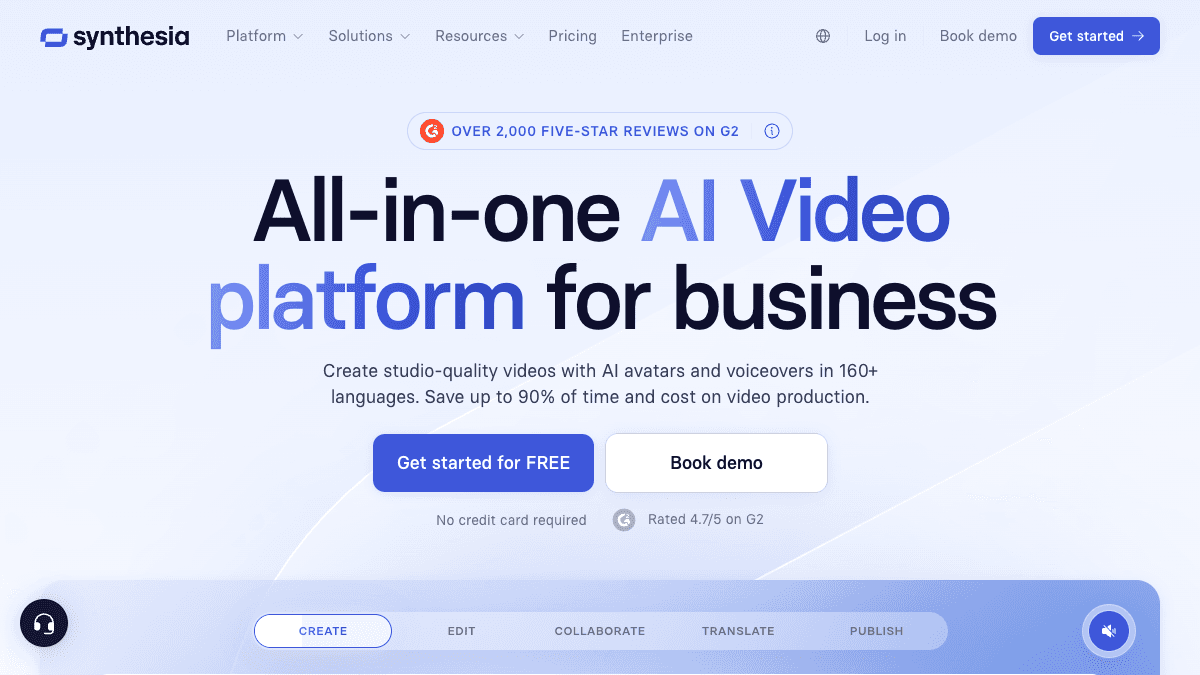
Synthesia's homepage positions the product as an all-in-one AI video platform for business. The page says creators can make studio-quality videos with AI avatars and voiceovers in more than 160 languages, and the navigation groups the platform around creating, localizing, managing, publishing, and engaging with AI video.
That tells you a lot about the category fit. Synthesia is not only a "make me a TikTok" tool. It is built for teams that want video communication at scale: training modules, sales enablement, internal updates, employee development, product explainers, compliance content, and localized video libraries.
Synthesia is worth testing if:
- You want an AI avatar or digital presenter on screen.
- You need business-friendly videos with a consistent on-brand presenter style.
- You care about translation, dubbing, multilingual playback, or updating videos over time.
- You want team collaboration, brand controls, analytics, or enterprise security features.
- You create training, HR, sales, operations, or knowledge-management content.
- You already have polished scripts and need a presenter format instead of a faceless visual story.
The tradeoff is focus. A high-quality avatar video still asks you to make avatar, voice, language, brand, script, scene, and disclosure decisions. That can be exactly right for a company training workflow. It can also be more production structure than a creator needs for a daily "one weird history fact" Short, a psychology list, or a faceless product tip.
Synthesia's Avatar Strength
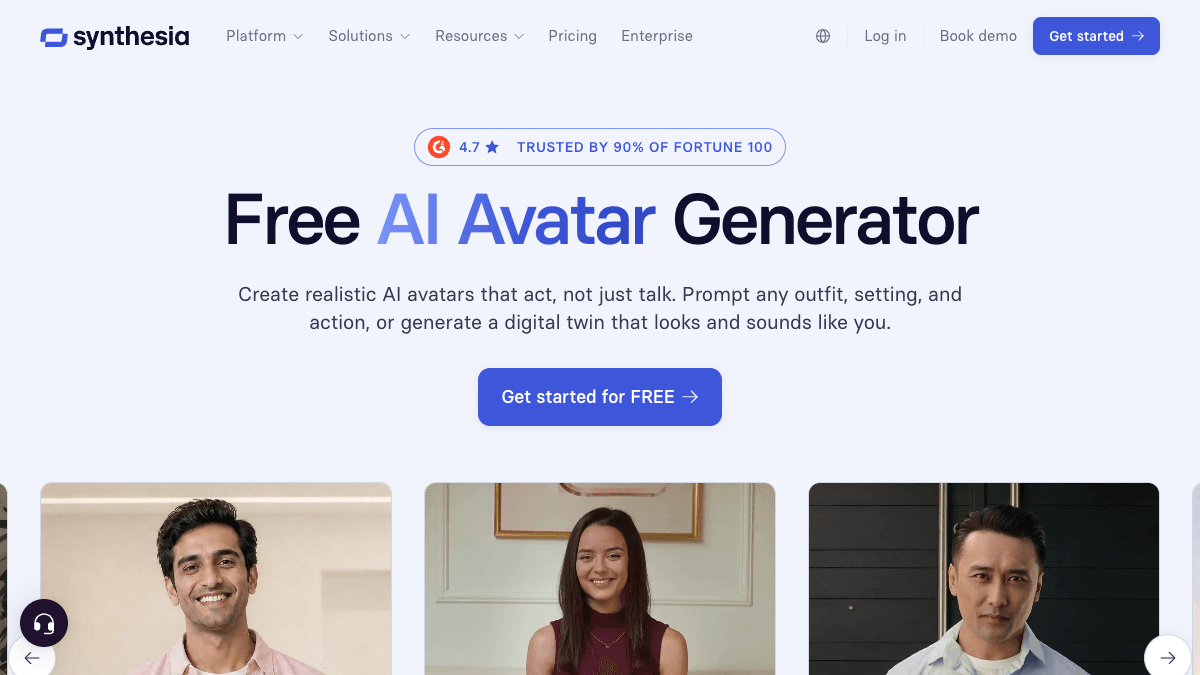
The Synthesia AI avatars page makes the strongest use case clearer. It describes realistic AI avatars that can act, not just talk, and it lists stock avatars, personal avatars, studio avatars, voice cloning, brand kits, analytics, and dubbing. The same page says Synthesia offers 240+ ready-made AI avatars and a large voice library across many languages.
For avatar-led video, those details matter. A sales training video may need a credible presenter. An internal update may need the same leadership tone across regions. A product explainer may need a calm spokesperson format that can be translated later. Synthesia is strong when the viewer should feel like someone is speaking directly to them.
For short-form social, the presenter is not always the point. Many winning Shorts, Reels, and TikToks are built around the idea, story, visual pattern, caption rhythm, or hook. A faceless channel can succeed without a digital human on screen if the narration and visuals carry the promise quickly.
That is the core Synthesia vs SwipeStory split:
| Question | Synthesia | SwipeStory |
|---|---|---|
| What is the main object? | A presenter-led AI video | A vertical short-form video |
| What do you start with? | Script, avatar, voice, language, brand, and business video goal | Topic, prompt, finished script, niche idea, or faceless series premise |
| Best audience | Teams creating training, enablement, product, HR, or localized communication | Creators and marketers building repeatable no-camera social videos |
| Visual center | AI avatar, presenter frame, scenes, brand assets, screen recordings, and business layouts | AI-generated or selected visuals, captions, narration, music, pacing, and social-ready output |
| Publishing goal | Business video libraries, embedded pages, LMS, links, localization, and team workflows | TikTok, YouTube Shorts, Instagram Reels, exports, and scheduled publishing |
Neither category is universally better. They solve different production problems. If your viewer needs a spokesperson, avatar video is useful. If your viewer needs a fast story, lesson, list, or visual idea, an avatar can become extra friction.
Synthesia Pricing Signals Checked June 21, 2026
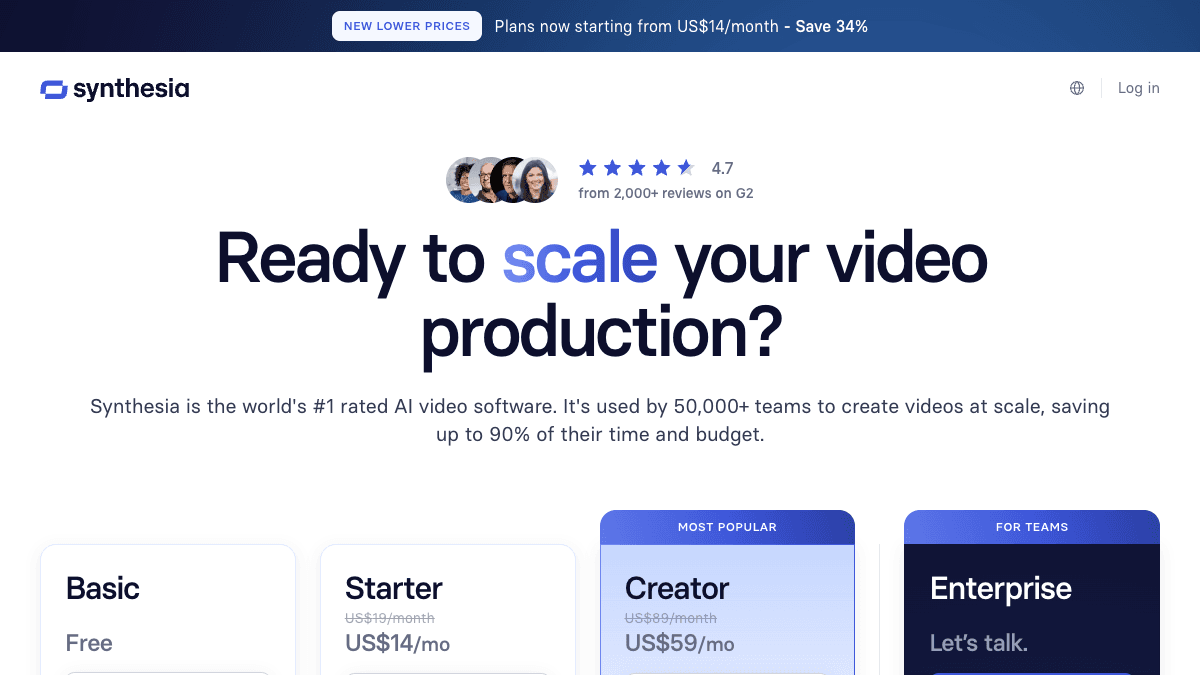
The live Synthesia pricing page showed a free Basic tier, self-serve Starter and Creator tiers, and custom Enterprise pricing during this check. The page also explains that credits are the shared currency for AI usage-based features, and its FAQ says the Starter plan provides 10 video minutes per month. Because promotional prices, billing toggles, regions, and checkout details can change, treat the pricing page as the source of truth before buying.
For a Synthesia alternative comparison, the bigger question is not only "which plan is cheaper?" It is "which workflow will spend fewer credits, minutes, and review cycles for the videos I actually publish?"
Use this buying checklist:
| Cost driver | Why it matters |
|---|---|
| Avatar or no avatar | Avatar videos can require more decisions around presenter fit, voice, expression, disclosure, and brand tone |
| Video length | A 10-minute training video and a 45-second Short should not be judged by the same plan math |
| Localization | Translation, dubbing, and multiple language variants can make Synthesia much more valuable |
| Revision cycles | Avatar choice, script timing, pronunciation, and brand review can add extra iterations |
| Publishing cadence | Daily social videos need repeatability more than one polished presenter video |
For SwipeStory, check the current pricing page before planning a high-volume series. SwipeStory's buying model should be judged around finished faceless drafts, credits, AI visuals, voiceovers, captions, rendering, series limits, and scheduled publishing.
Why Short-Form Video Changes The Decision
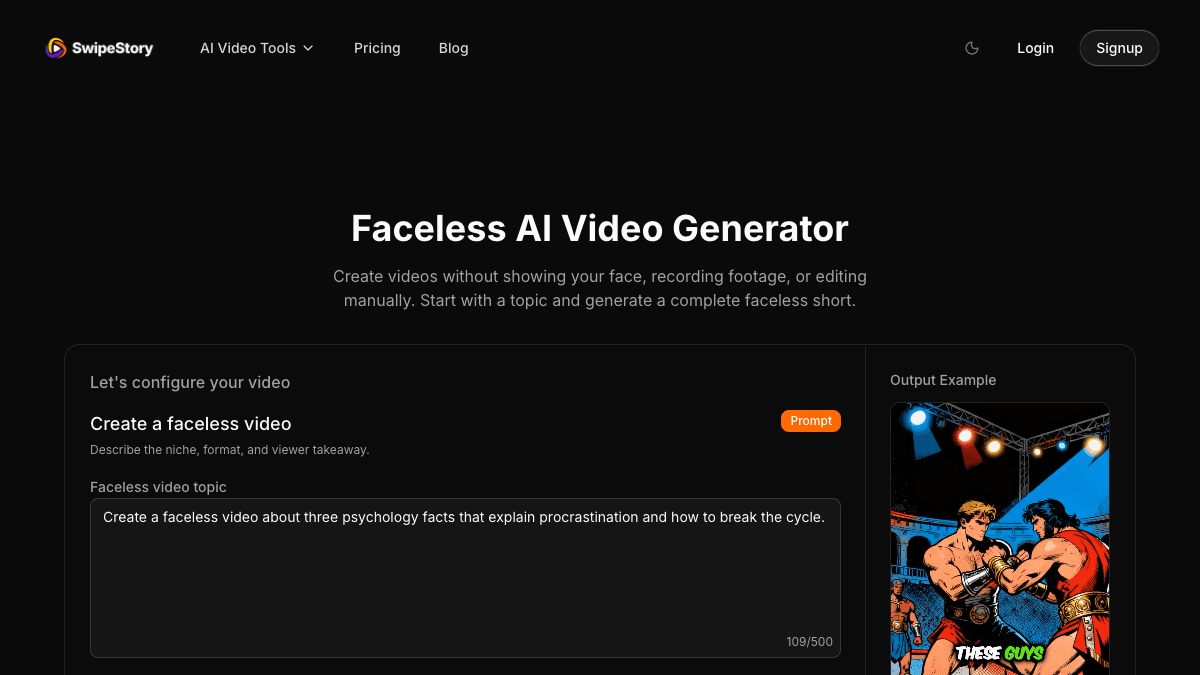
SwipeStory is the stronger Synthesia alternative when the starting point is a niche idea, hook, narration script, or recurring faceless series. The public tool page describes a workflow that turns a topic into a faceless social video with AI-generated visuals, narration, captions, music options, and social-ready pacing.
Short-form video has a different production rhythm from avatar-based business video. A team might spend weeks polishing a training library. A creator might need five usable drafts before Friday. In that second workflow, the most valuable feature is often not a better avatar. It is a repeatable path from idea to mobile-ready output.
For example, a creator planning a "daily business mistake" series needs:
- Five hooks that each make a clear promise.
- Short scripts with one idea per video.
- A consistent voice and visual style.
- Captions that are readable on a phone.
- Music and pacing that do not distract from the lesson.
- A way to review, export, and schedule the batch.
That is where AI TikTok video generator, AI YouTube Shorts generator, and AI Reel generator workflows fit naturally with SwipeStory. The tool should reduce handoffs between a script writer, voice generator, image generator, caption editor, renderer, and scheduler.
Synthesia can still be part of a social stack. Use it when an avatar presenter improves trust, clarity, or localization. But if every video starts with "What should the avatar say?" instead of "What will stop the scroll?", you may be solving the wrong problem for short-form growth.
Platform Checks Still Matter
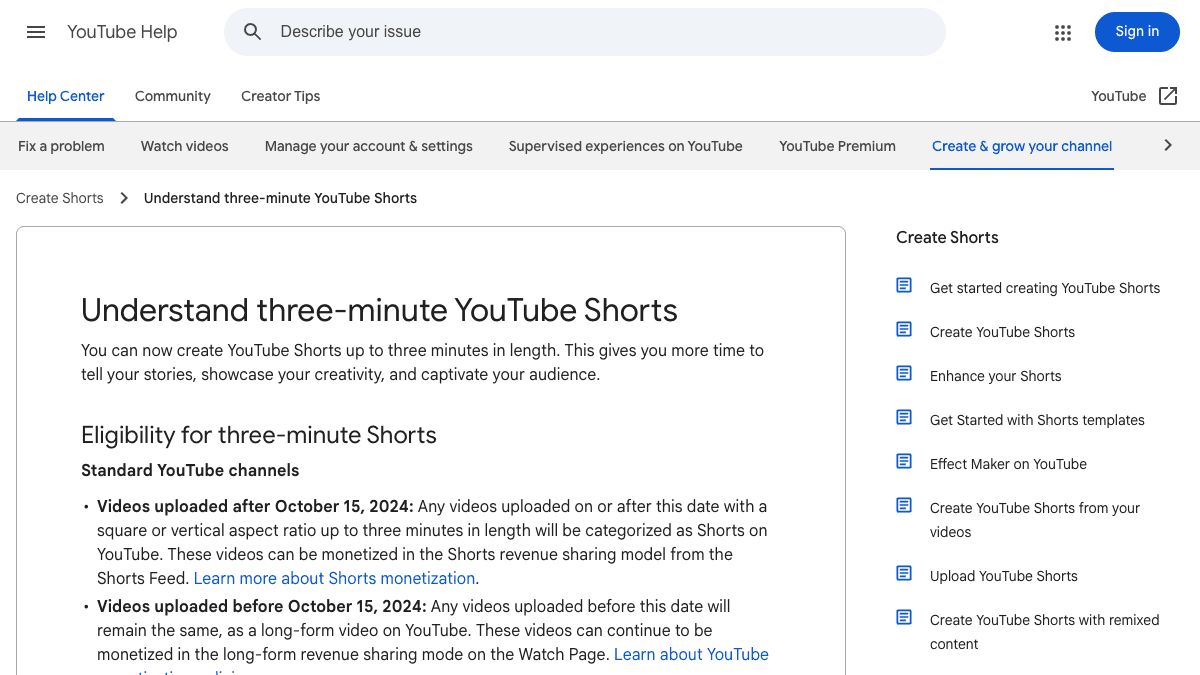
No Synthesia alternative removes the final platform review. Before publishing AI avatar videos or faceless generated videos, check length, aspect ratio, safe zones, music rights, disclosure requirements, and whether the video still makes sense without extra context.
YouTube Help currently says standard channel uploads after October 15, 2024 with a square or vertical aspect ratio and length up to three minutes are categorized as Shorts. It also says a Short over one minute with an active Content ID claim can be blocked globally until the claim is resolved.
TikTok's auction in-feed ad specifications are ad-focused, but they are still useful production guardrails. The March 2026 update lists vertical 9:16 as the recommended Non-Spark ad dimension with at least 540 x 960 pixels, supports common video formats such as MP4 and MOV, and points creators to safe-zone files because captions, anchors, and app UI can affect what stays visible.
For both Synthesia and SwipeStory, review the final video on a phone-sized frame:
- Is the hook clear in the first seconds?
- Are captions readable and away from bottom controls?
- Is the important visual centered in a vertical crop?
- Does an avatar improve trust, or does it slow the story down?
- Are AI, avatar, music, and stock-media rights clear enough for the use case?
- Can you repeat the format tomorrow without rebuilding the whole production setup?
When Synthesia Is The Better Choice
Choose Synthesia when the presenter format is central to the video:
- You need an AI avatar, digital twin, or realistic spokesperson.
- You create training, compliance, sales enablement, HR, support, or internal communication videos.
- You need localization, translation, dubbing, or multilingual playback.
- You care about brand kits, collaboration, analytics, version control, or enterprise controls.
- You publish videos into business systems, embedded pages, internal libraries, or LMS workflows.
- Your team values polished, consistent communication more than fast daily social output.
For example, a global operations team translating safety training into multiple languages should not choose a short-form generator just because it is faster for TikTok. Synthesia's avatar and localization workflow is closer to that job.
When SwipeStory Is The Better Choice
Choose SwipeStory when the job is short-form production:
- You do not want to film yourself or use an avatar presenter.
- You start with a topic, hook, niche idea, or finished narration script.
- You publish on TikTok, YouTube Shorts, and Instagram Reels.
- You need AI-generated visuals, voiceover, captions, background music, editing, rendering, and scheduling in one flow.
- You care about repeatable faceless series output more than business-video localization.
- You want reviewable vertical drafts instead of assembling every scene manually.
For example, a creator building 30 "one-minute startup lessons" does not need a digital human in every episode. They need a reliable structure, visual rhythm, narrator, caption style, and publishing schedule. Pair SwipeStory with the AI video prompts for Shorts, AI video script generator guide, and AI voiceover video maker guide to improve the inputs before generation.
If you are comparing adjacent avatar and voiceover tools, read the HeyGen alternative for faceless shorts, Fliki AI alternative, and InVideo AI alternative guides. Those tools sit near the same buying decision, but each has a different center of gravity.
A Practical Switching Test
Do not migrate your entire stack because one landing page looks better. Run a narrow test around your real output.
Use this one-hour comparison:
| Step | Synthesia test | SwipeStory test |
|---|---|---|
| 1 | Pick one script that benefits from a presenter | Pick one topic that can work as a faceless Short |
| 2 | Choose avatar, voice, language, and brand frame | Choose style, voice, platform, and duration |
| 3 | Generate one finished draft | Generate one finished draft |
| 4 | Review on a phone-sized frame | Review on a phone-sized frame |
| 5 | Count script, visual, caption, voice, and export fixes | Count script, visual, caption, voice, and export fixes |
| 6 | Decide whether video two would be easier | Decide whether video two would be easier |
Then ask the practical question: which workflow makes the next ten videos easier?
If Synthesia wins, the presenter format is likely important to your content. Keep it. If SwipeStory wins, the avatar layer was probably not the bottleneck. Move one repeatable faceless series first, then keep Synthesia for presenter-led assets that still need a human-like on-screen delivery.
Best Synthesia Alternatives To Consider
1. SwipeStory: Best For Faceless Short-Form Series
SwipeStory is the best Synthesia alternative when your main job is repeatable no-camera TikToks, YouTube Shorts, and Instagram Reels from prompts or scripts. It is strongest when you want one workflow for idea, narration, visuals, captions, music, rendering, review, and publishing.
Start with faceless AI video generator for no-camera channels, Script to Video AI when narration is final, or Prompt to Video when you only have the angle.
2. HeyGen: Better For Avatar UGC And Digital Twins
HeyGen is a better fit when you want avatar-led ads, digital twins, multilingual presenter videos, or UGC-style creative with a person-like spokesperson. Read the HeyGen alternative for faceless shorts guide if your real decision is avatar presenter versus faceless creator workflow.
3. InVideo Or Fliki: Better For Broader AI Video Suites
InVideo and Fliki are worth testing when you want a broader AI media suite, voiceover-led video creation, stock assets, script-to-video workflows, or multiple format experiments. See the InVideo AI alternative and Fliki AI alternative comparisons if your project is not strictly avatar-first.
4. Keep Synthesia If Avatar Video Is The Main Value
Do not switch away from Synthesia just because a faceless workflow is faster. If your team depends on avatar presenters, localization, business-video governance, analytics, or enterprise controls, Synthesia may stay in your stack. Add SwipeStory when you also need recurring faceless short-form videos that do not require a presenter.
Final Recommendation
Use Synthesia if your video needs a credible AI presenter, multilingual avatar delivery, business training format, or company-scale video communication workflow. It is a strong AI avatar video generator, and it can be the right choice when the synthetic presenter is central to the message.
Use SwipeStory if your biggest bottleneck is making original no-camera short-form videos from ideas. It is the better Synthesia alternative for creators who need repeatable TikToks, YouTube Shorts, and Instagram Reels with AI visuals, voiceover, captions, music, rendering, and scheduled publishing.
The simplest decision is this: if the viewer needs to see a presenter, test Synthesia. If the viewer needs a fast faceless story, lesson, list, or visual idea, test SwipeStory and measure how many reviewable vertical drafts you can make in one focused session.
Frequently Asked Questions
What is the best Synthesia alternative for short-form video?
SwipeStory is the best Synthesia alternative for short-form video when you want original faceless TikToks, YouTube Shorts, and Instagram Reels from prompts or scripts instead of avatar presenter videos.
Is Synthesia better than SwipeStory?
Synthesia is better for AI avatars, presenter-led business videos, localization, training, and enterprise communication workflows. SwipeStory is better for repeatable faceless short-form videos with AI visuals, narration, captions, music, rendering, and scheduled publishing.
Can Synthesia make social media videos?
Yes. Synthesia's avatar page lists social media content as one of the avatar use cases, and avatar videos can be exported or adapted for social channels. The main question is whether the video needs an avatar presenter or whether a faceless short-form workflow would be faster and more repeatable.
Should I use an AI avatar for Shorts?
Use an AI avatar when the presenter builds trust, explains a product, localizes a message, or makes the ad concept clearer. Use a faceless AI video workflow when the story, lesson, visuals, captions, or niche format matters more than seeing a synthetic person.
Can I use Synthesia and SwipeStory together?
Yes. Use Synthesia for avatar-led explainers, training clips, localized presenter assets, or business communication. Use SwipeStory for recurring faceless organic videos, scripts, visuals, voiceover, captions, rendering, and publishing across short-form platforms.
