Social Video Funnels Explained: Your 2026 Strategy Guide

Stella writes SwipeStory guides about AI faceless video creation, short-form video strategy, creator tools, and automated publishing workflows.
What is a social video funnel, and why does it matter?
A social video funnel is a structured sequence of videos that guides your audience from first discovering your brand all the way to becoming a loyal customer. Rather than posting random clips and hoping something sticks, you map specific video content to each stage of the buyer's journey, with a distinct purpose at every step.
The four core stages are:
- Awareness: Short, attention-grabbing clips that introduce your brand or a problem your audience recognizes
- Consideration: Educational content, demos, and explainers that build trust and answer real questions
- Decision: Testimonials, case studies, and walkthroughs that remove hesitation and drive action
- Retention: Onboarding videos, how-to guides, and updates that keep customers engaged after the sale
What separates a video funnel from a random content calendar is intent. As 7 Hills Productions puts it, a funnel strategy treats video as staged communication, where every asset has a role rather than existing as a one-off creative project. The result is a content library that works together, moves people forward, and produces measurable outcomes.
Table of Contents
- How each stage of the funnel works in practice
- Common pitfalls that kill social video funnel results
- Best practices and 2026 trends for social video funnel success
- How Swipestory helps you build a social video funnel faster
- How to sharpen audience targeting within your funnel
- Key Takeaways
How each stage of the funnel works in practice
Awareness
Your audience does not know you yet, or they are not thinking about your product. The goal is to get on their radar without pushing a sale. Short, engaging clips of 20–30 seconds work well here, as do social ads and educational teasers that spark curiosity. Focus the message on the problem, not the product. Every awareness video should point to a next step, moving viewers off social platforms and into your own ecosystem.
Consideration
Viewers at this stage are comparing options and want specifics. Your videos should shift from emotional to rational, explaining how your product works, what makes it different, and what outcomes customers can expect. Explainers, demos, and behind-the-scenes walkthroughs all fit here. Each funnel stage has distinct goals and appropriate formats, and consideration content typically lives on landing pages, email sequences, or your website rather than purely on social feeds.

Decision
People at the bottom of the funnel know who you are. They just need a final push. Customer testimonials and case studies provide the social proof that others have succeeded. Personalized demos and product walkthroughs show exactly what the buyer will experience. Keep the next step obvious and friction-free. A confused prospect does not convert.
Retention
The funnel does not end at the sale. Onboarding videos, feature updates, and how-to content reinforce the value of what customers just bought and reduce churn. The best retention content also turns satisfied customers into advocates who generate new awareness, restarting the cycle.
Common pitfalls that kill social video funnel results
Most creators run into the same handful of problems. Recognizing them early saves a lot of wasted production time.
- Chasing viral content instead of funnel outcomes. A video that racks up views but attracts the wrong audience at the wrong stage does nothing for your pipeline. Treating video as staged communication rather than a lottery ticket is what separates high-performing funnels from one-hit wonders.
- Reusing the same video across all stages. High-performing funnels require multiple purpose-built videos for effective remarketing. One clip cannot serve a cold audience and a warm lead simultaneously.
- Ignoring platform-specific requirements. A LinkedIn video and a TikTok clip need completely different structures, lengths, and hooks, even if the underlying message is the same.
- Underestimating volume. One well-known campaign referenced in the AdLeaks analysis used more than 50 videos to support a large ad spend across every funnel stage. Most brands start with far fewer than they need.
- Weak hooks. The hook must be visual or auditory within the first two seconds on platforms like TikTok and Instagram Reels. A text-only opener loses viewers before the message lands.
- Skipping audience segmentation. Serving the same video to cold and warm audiences wastes budget and dilutes your message. Retargeting based on prior video engagement is what makes the funnel actually function as a funnel.
- Ignoring completion rates. View count, watch time, engagement, click-through rate, and follower growth are the metrics that reveal whether your funnel is working. Watch time and completion rate matter most because platforms reward them algorithmically.
Best practices and 2026 trends for social video funnel success
The biggest shift in 2026 is that authenticity and lo-fi storytelling are outperforming polished, high-production content on most social platforms. Live streams build trust that pre-recorded videos struggle to match. Audiences reward creators who feel real over those who feel like ads.
A few practices that consistently produce results:
- Nail the hook in the first two seconds. Combine a visual trigger with an audio cue. On TikTok, users swipe away almost immediately if the opening does not grab them.
- Batch film to hit volume. Batch filming and AI tools are the most practical answer to the volume problem. One production day can yield 10–15 distinct videos when scripts are prepared in advance.
- Build for vertical formats. TikTok, Instagram Reels, and YouTube Shorts all reward 9:16 video. LinkedIn is the exception, where document-style and native uploads outperform links.
- Automate delivery. Automating video sales funnels through landing pages, retargeting ads, and upsell sequences turns a one-time view into a multi-touch journey without manual effort.
- Track the right metrics per stage. Awareness is measured by reach and watch rate. Consideration by average view duration and click-through. Decision by demo requests and conversions. Retention by repeat usage and lifetime value.
"A full funnel video strategy creates continuity. Each asset has a role. Awareness videos introduce. Consideration videos educate. Decision stage videos reduce hesitation. Retention content improves the client experience. When the system is planned this way, video becomes a structured communication engine." — 7 Hills Productions
Pro Tip: Plan your content cascade before you film. One long-form video can become five or six short-form clips, a LinkedIn post, and an Instagram carousel. Mapping this repurposing strategy upfront means you get far more funnel coverage from each production session.
How Swipestory helps you build a social video funnel faster
Swipestory is built specifically for the volume and variety that a real video funnel demands. The platform automates the entire production process, from scriptwriting through voiceovers to final rendering, so you can generate a full set of funnel assets without a production crew.
Key capabilities that map directly to funnel needs:
- Script-to-video automation: Feed Swipestory a concept and it produces a finished video, including voiceover and captions, ready for export. This is how you build the 50-plus assets a full funnel campaign requires without burning out.
- Customizable captions and image generation: Every video can be adapted for platform-specific requirements, whether that means bold captions for silent TikTok viewers or different aspect ratios for Reels versus LinkedIn.
- Cloud rendering and multi-platform export: Videos render in the cloud and export directly to the formats each platform needs, cutting the manual work out of distribution.
- Over 60,000 short videos generated: Swipestory's creator base has already produced this volume of content, which reflects the platform's reliability at scale.
The Swipestory blog covers production best practices in depth, from structuring a campaign to optimizing for each platform. For creators who want to go faceless or automate series content, the faceless video automation tools handle that without requiring on-camera talent.
Pro Tip: Use Swipestory's AI video generator to produce your awareness and consideration videos in one session. Script variations for each funnel stage, batch-generate them, then schedule them across platforms. You get a complete funnel in hours, not weeks.
How to sharpen audience targeting within your funnel
Targeting is where most video funnels either pay off or fall apart. The content can be excellent, but if it reaches the wrong person at the wrong stage, it will not convert.
Start by defining distinct audience segments for each funnel stage. Cold audiences who have never interacted with your brand belong at the top. Warm audiences who have watched at least 50% of a previous video are ready for consideration content. Anyone who has visited your landing page or clicked a CTA is a bottom-of-funnel prospect.
Use platform retargeting tools to serve the right video to each segment automatically. Facebook and Instagram let you build custom audiences from video viewers, segmented by watch percentage. TikTok offers similar options. This is what turns a collection of good videos into an actual funnel rather than a broadcast.
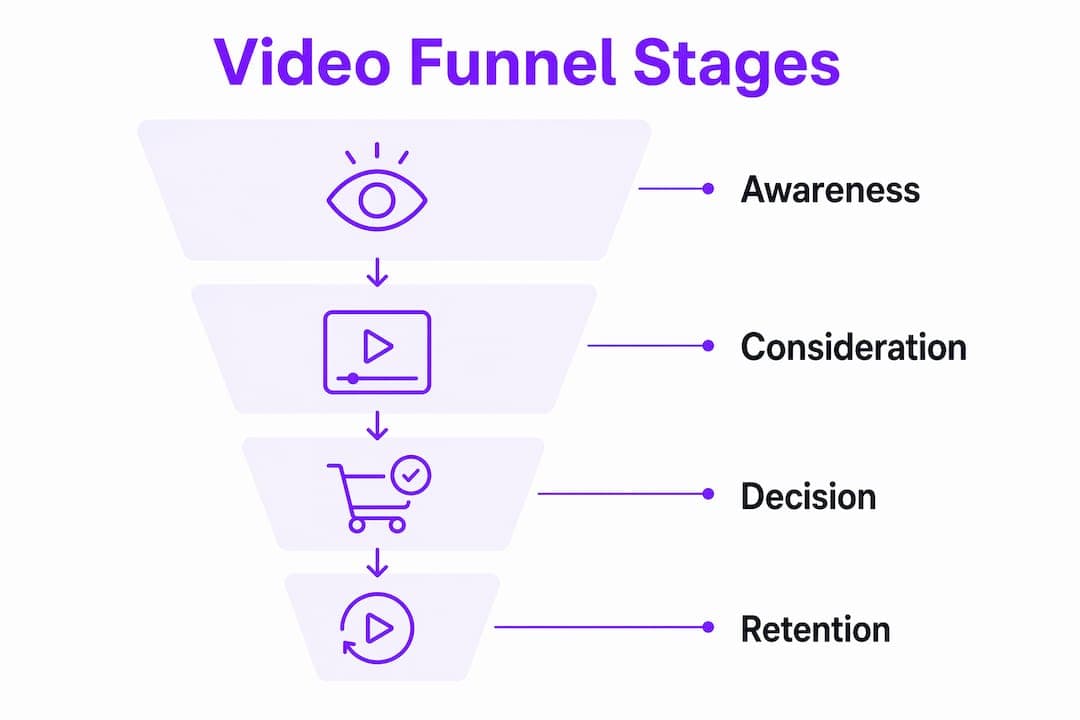
Tubular Labs research on social video funnel optimization frames each stage around a single objective: entertain at awareness, educate at consideration, sell at conversion, and nurture at loyalty. Aligning your targeting strategy to those objectives keeps your ad spend focused and your messaging consistent.
For B2B marketers, platforms like TrailerCast integrate video funnel analytics with lead nurturing workflows, connecting viewership data directly to pipeline activity. Pair that kind of infrastructure with an AI automation agency to handle retargeting sequences, and the funnel runs with minimal manual intervention.
Segment early, retarget precisely, and measure completion rates at every stage. That combination is what turns social video from a brand awareness exercise into a reliable conversion system.
Key Takeaways
A social video funnel works because it matches the right video format and message to each stage of the buyer's journey, replacing random content with a system that moves people toward a decision.
| Point | Details |
|---|---|
| Four-stage structure | Awareness, Consideration, Decision, and Retention each require distinct video formats and goals. |
| Volume matters | Effective funnel campaigns require multiple purpose-built videos, not one repurposed clip. |
| Hook within two seconds | Visual and auditory hooks in the first two seconds are required to retain viewers on short-form platforms. |
| Authenticity wins in 2026 | Lo-fi storytelling and live streams outperform polished production on most social platforms. |
| Measure per stage | Track reach and watch rate at awareness, view duration at consideration, and conversions at decision. |
Ready to build your video funnel without the production bottleneck? Swipestory's AI video generator takes you from script to finished video in minutes, so you can cover every funnel stage at the volume real campaigns require. Start creating with the social media video maker and see how fast a complete funnel comes together.
